
Emergency Shower Requirements in Alberta | Industrial Sites
When Is an Emergency Shower Required on an Industrial Site in Alberta?
Emergency shower requirements in Alberta come down to exposure risk. If workers may contact chemicals or harmful substances that can injure the skin or eyes, the site needs immediate access to appropriate emergency washing equipment before the work starts.
For industrial operators, this is not just a compliance exercise. Emergency showers and eyewash stations are part of the site’s real emergency response capability. PPE, procedures, and training reduce exposure risk, but they do not eliminate the need for fast decontamination when a splash, spray, spill, hose failure, or line-break incident happens.
For Smite Industrial’s customers in oil and gas, mining, manufacturing, agriculture, forestry, construction, and shutdown work, the practical issue is straightforward: the unit has to be close enough, functional, winter-ready, documented, and ready to use in the field.
When Is an Emergency Shower Required on an Industrial Site in Alberta?
The key Alberta requirement is found in the Alberta OHS Code, Part 4, Section 24 – Emergency baths, showers, eye wash equipment. In practical terms, when chemicals harmful to the eyes or skin are used at a work site, workers must have immediate access to emergency washing equipment that fits the potential level of exposure.
Section 23 is also important. If a worker may be contaminated by a harmful substance at a work site, the employer must provide the facilities, including showers, needed to remove the contamination before the worker leaves the site.
That means the requirement is risk-based. It is not limited to permanent buildings, large plants, or long-term facilities. If the work creates a credible skin or eye exposure risk, emergency decontamination access needs to be part of the plan.
This also connects to the site hazard assessment. Alberta OHS Code, Part 2 requires employers to identify existing and potential hazards before work begins, document how those hazards will be controlled, and repeat the assessment when work processes or conditions change.
Common Industrial Situations Where Emergency Shower Coverage May Be Required
Emergency shower coverage should be reviewed anywhere workers may be exposed to substances that can damage skin, eyes, tissue, or clothing. Common examples include:
- Chemical handling, transfer, mixing, injection, or dosing
- Caustic, acid, solvent, degreaser, surfactant, or cleaning-agent use
- Hydrocarbon processing, tank cleaning, vessel cleaning, and exchanger work
- Produced fluids, bitumen, condensate, contaminated water, or process-fluid handling
- Line breaking, valve work, hose connections, pump swaps, and temporary circulation setups
- Spill response, decontamination, and emergency cleanup activities
- Shutdowns, turnarounds, maintenance outages, and temporary construction projects
- Remote work sites without reliable fixed water, power, or safety infrastructure
The trigger is not whether the job is permanent or temporary. The trigger is whether the exposure risk exists and whether workers can reach appropriate emergency washing equipment immediately if something goes wrong.
Why PPE Alone Is Not Enough
PPE is critical, but PPE is not a complete emergency response plan. Gloves tear. Face shields get lifted. Clothing becomes contaminated. Hoses fail. Valves leak. Workers make mistakes, especially during fast-moving shutdown and maintenance work.
The Canadian Centre for Occupational Health and Safety notes that the first seconds after exposure to hazardous products are critical and that emergency showers and eyewash stations provide on-the-spot decontamination. That is the point: the emergency shower is the backup that reduces injury severity when preventive controls do not fully stop exposure.
A serious site plan treats PPE, procedures, training, hazard assessment, and emergency decontamination as a connected control system – not as separate checkboxes.
How “Immediate Access” Should Be Interpreted in the Field
Alberta OHS uses the phrase immediate access. The Code does not turn every work site into the same layout exercise, because the right answer depends on the chemical, the exposure severity, the work process, and the site conditions.
In practical HSE planning, immediate access should mean:
- The emergency shower and eyewash unit is close enough to the exposure area to be useful during an actual incident.
- The access route is visible, direct, and not blocked by scaffolding, hoses, trucks, fencing, equipment, stairs, locked doors, or process hazards.
- The unit remains accessible during nightshift, winter conditions, poor weather, and active construction or turnaround work.
- The unit is clearly identified in the site orientation, FLHA/JSA, emergency response plan, and toolbox meetings.
- The unit is inspected, operational, filled, powered, temperature-controlled, and documented before high-risk work begins.
A shower located somewhere else on site is not automatically good enough. If a contaminated or partially blinded worker cannot reach it fast and safely, the control may not be practical.
How Emergency Shower Requirements Are Typically Enforced
Emergency shower compliance is usually reviewed through the broader HSE system: hazard assessments, SDS review, exposure controls, emergency response planning, first aid readiness, and worker training. Regulators and client auditors are not only looking for equipment. They are looking for a documented, functioning control.
Alberta OHS administrative penalties show that emergency washing and decontamination obligations are enforceable. In 2025, GP Food Services Inc. was penalized in Grande Prairie under Section 24 for failing to ensure workers exposed to chemicals harmful to the eyes or skin had immediate access to appropriate emergency washing equipment. In 2020, Strike Contracting Ltd. was penalized in Slave Lake under Section 23 for failing to provide decontamination facilities for workers exposed to a harmful substance.
Those examples are not the same as every industrial site, and public summaries do not provide every incident detail. But they make the compliance point clear: emergency washing requirements are not theoretical.
Where Temporary Emergency Shower Units Fit
Fixed emergency showers can be effective when the work is close to permanent infrastructure. The problem is that many industrial projects do not happen in ideal locations. Work fronts move. Shutdown areas shift. Remote leases may not have water or power. Outdoor work may happen in freezing conditions. Permanent showers may be too far away, locked out, offline, or blocked by active work.
This is where temporary emergency shower rentals solve a real field problem. They bring emergency decontamination capability to the work front instead of forcing workers to rely on distant infrastructure.
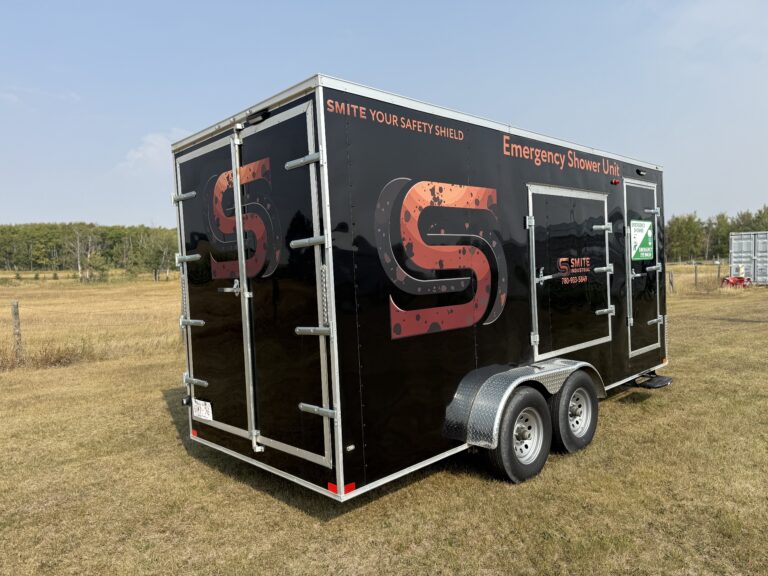
Smite Industrial provides fully self-contained, 18-foot insulated dual-axle emergency shower units built for Western Canadian industrial conditions. Each unit includes onboard potable water, a full emergency shower and eyewash station, temperature-controlled water, onboard generator power with optional 30A site power connection, low-entry access, controlled discharge with no water to ground, current CVIP readiness, and support for delivery, setup, and demobilization.
For HSE teams, that translates into a simpler execution model: the unit arrives field-ready, documented, winter-capable, and positioned where the exposure risk actually exists.
Emergency Shower Planning Checklist
Before starting work, HSE and project teams should be able to answer these questions:
- What harmful substances are present, and what does the SDS say about skin or eye exposure?
- Could a worker be splashed, sprayed, soaked, or contaminated during normal work or a failure event?
- Is the existing fixed emergency shower close enough and accessible enough for the actual work front?
- Does the work move during the project, shutdown, or turnaround?
- Is the emergency washing equipment usable in winter, nightshift, mud, ice, or remote-site conditions?
- Is eyewash available as well as full-body shower coverage?
- Is the unit inspected, documented, filled, powered, temperature-controlled, and ready for audit?
- Is the unit location included in the emergency response plan, site orientation, and daily work planning?
Bottom Line
An emergency shower is required when the work creates a credible risk of harmful skin or eye exposure and workers need immediate access to emergency decontamination.
For Alberta industrial sites, that decision should be made through the hazard assessment, SDS review, work-front layout, client HSE requirements, and emergency response plan – not after mobilization.
If your crew is handling chemicals, hydrocarbons, corrosives, process fluids, contaminated water, or hazardous substances, emergency shower coverage should be part of the pre-job plan.
Let Smite Industrial Help!
Need emergency shower coverage for an industrial site, shutdown, turnaround, or remote project? Smite Industrial can help you assess the work front and deploy self-contained emergency shower units where they are needed. Give us a call at (780) 933-5849 or use our form below to easily request a quote. One of our team members will assist you right away.
Alberta OHS Code Part 4, Section 24 covers emergency baths, showers, and eyewash equipment where chemicals harmful to the eyes or skin are used. Section 23 also addresses decontamination facilities, including showers, when a worker may be contaminated by a harmful substance.
A temporary emergency shower should be planned when hazardous-substance exposure risk exists and fixed emergency washing equipment is not close enough, accessible enough, operational, or practical for the work front.
No. PPE is an important control, but it does not eliminate the need for emergency decontamination where workers could still be exposed through splash, spray, leaks, equipment failure, or human error
Alberta OHS requires immediate access at the work site. The specific placement should be determined through the hazard assessment, SDS review, site standards, client HSE requirements, and the severity of the exposure risk.
Eyewash bottles can support immediate first response, but they should not be treated as a replacement for appropriate emergency shower and eyewash equipment when a credible exposure risk requires full emergency washing capability.
Yes. Smite provides self-contained, insulated emergency shower units designed for Western Canadian industrial sites, remote locations, shutdowns, turnarounds, and temporary project work.